
How common is the Omicron variation in the United States? Given its unique characteristics—it appears to cause milder sickness but spreads much more quickly—a it’s critical public health issue that necessitates a new way of thinking about personal and community dangers. Given the time it takes to sequence and report samples, it’s also a difficult question to answer in real time.
The US Centers for Disease Control and Prevention (CDC) reported just before Christmas that Omicron was responsible for 73 percent of the country’s most recent cases. That number, which marked a startling sixfold growth in just a week, stuck with us and has shaped our collective thinking about the pandemic’s current situation ever since.
However, the CDC updated its initial estimate to 23 percent a week later, indicating that although everyone was focused on Omicron, Delta, a nastier, more fatal variety, was remained the main concern.
Researchers have had more time in the weeks since to figure out how Omicron is spreading across the population. That kind of real-world data is exactly what they need to improve their modeling, so their most recent predictions are likely to be more accurate. And what are the results of those projections?
Omicron is virtually widespread, accounting for nearly all new cases in the United States. This is true across the country, while some areas, such as New England and the Midwest, still have a significant amount of Delta, as shown in gray on the pie charts below:
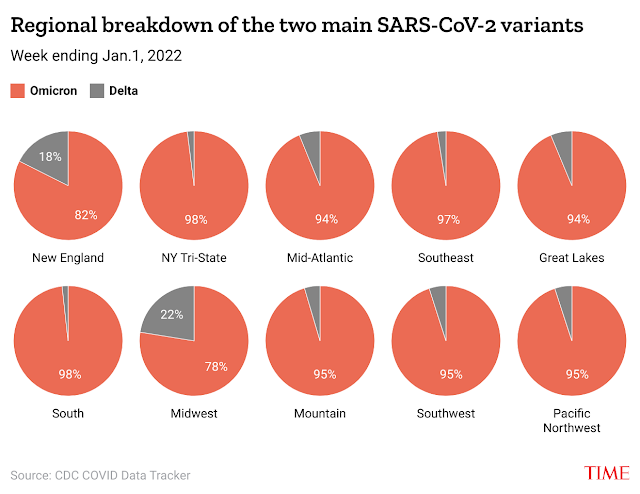
Nonetheless, the most recent data are what the CDC refers to as a “Nowcast,” which is a model that forecasts the current situation based on prior trends. The most current real data is from the week ending Dec. 28, when Delta accounted for over 62% of all incidents.
While it’s evident that Omicron is on the verge of a statewide takeover, we can’t be certain it’s actually happened; after the surveillance and sequencing work is completed, the current Nowcast data could be revised downward. Indeed, there are hints that Delta isn’t completely gone: it still accounts for about 40% of new cases at the U.S. Capitol’s testing lab in Washington, D.C., for example.
Many of us, from lawmakers to school officials to ordinary citizens, have rethought the pandemic in light of the fact that we’re now dealing with a milder strain of the virus—one that spreads so quickly that infection appears all but unavoidable. What’s less obvious is how many individuals realize that such reasoning is based on early data that will be revised later.
The CDC’s Nowcast is a very helpful public health tool, but it can’t be more than a guess. The more cautious among us, such as the immunocompromised and others at high risk, should act as though Delta is still there, at least until more conclusive data becomes available. (By Alex Fitzpatrick)


